How to Build a Social Selling Playbook for Your Team
Telling your sales team to "use LinkedIn" is not a strategy. It's a recipe for inconsistent messaging, random acts of outreach, and a pipeline that is anything but predictable. Without a unified plan, each rep is left to their own devices, leading to brand damage and wasted effort. If you want to transform your team into a high-performing social selling machine, you need a playbook.
A social selling playbook is a centralized guide that outlines your team's strategy, processes, and best practices for using social media to find, engage, and nurture prospects. It's the single source of truth that ensures every team member is executing a coordinated, effective strategy. This guide will provide you with a clear, step-by-step framework for building a social selling playbook that drives consistent, measurable results.
What is a Social Selling Playbook?
Think of a social selling playbook as the "rules of the road" for your team's activity on platforms like LinkedIn. It’s a living document that defines:
- Who to target: Your Ideal Customer Profile (ICP) and key buyer personas.
- What to say: Standardized messaging, value propositions, and content pillars.
- How to act: Engagement strategies, outreach cadences, and daily routines.
- How to measure success: The key performance indicators (KPIs) that matter.
A playbook turns individual, sporadic efforts into a cohesive, scalable system that everyone on the team can execute with confidence.
Pillar 1: Standardize Your Team's Professional Brand
Your team's LinkedIn profiles are your digital storefront. They must be consistent, professional, and optimized to speak directly to your ICP.
- Profile Photo and Banner: Mandate professional, high-quality headshots and provide a branded LinkedIn banner for every team member to use.
- Headline Formula: Provide a clear formula for headlines that focuses on the prospect, not just the job title.
- Formula:
[Job Title] | Helping [Your ICP] Achieve [Specific Outcome] - Example:
Account Executive | Helping E-commerce Brands Reduce Cart Abandonment Rates
- Formula:
- "About" Section Template: Give your team a template for their "About" section using the Problem-Agitate-Solve framework to ensure a consistent, customer-centric message.
Pillar 2: Define Your Ideal Customer Profile (ICP)
Your team cannot hit a target it cannot see. The playbook must contain a single, hyper-specific definition of your ICP.
- Collaborate: Work with both sales and marketing to build a consensus on the ICP.
- Be Specific: Go beyond industry and company size. Define the specific job titles, seniority levels, and key challenges of the people you are targeting.
- Create Saved Searches: Build a shared library of LinkedIn Sales Navigator "saved searches" that your entire team can use to find a consistent stream of qualified leads.
Pillar 3: The Engagement & Content Strategy
This section of the playbook defines how your team will provide value and build trust before asking for the sale.
- The 90/10 Rule: Mandate that 90% of your team's activity should be providing value (sharing content, commenting) and only 10% should be "asking" (sending connection requests or pitching).
- Content Pillars: Define 3-5 core topics (content pillars) that are directly related to your ICP's pain points. Your marketing team should create content around these pillars, and your sales team should be trained to share and engage with it.
- The Daily Engagement Routine: Instruct your team to spend 15 minutes each day leaving thoughtful, insightful comments on posts from key prospects and industry influencers.
Pillar 4: Standardize Outreach Cadences and Messaging
This is the "plays" section of your playbook. It provides your team with a library of approved, on-brand message templates for different scenarios.
- Connection Request Templates: Create templates for different segments (e.g., based on a mutual connection, content engagement, or a trigger event).
- Follow-Up Sequences: Design a 3-5 step follow-up sequence for new connections. This should be a value-driven sequence that nurtures the relationship over time.
- Message 1 (Day 3): Share a helpful resource.
- Message 2 (Day 7): Ask an insightful question.
- Message 3 (Day 14): Transition to a soft call-to-action.
Pillar 5: The Tech Stack - Systematizing with Tools
A playbook is only as good as its execution. Manually managing outreach for an entire team is a recipe for failure. To ensure consistency and scalability, you must leverage technology. This is where a secure and centralized automation tool becomes the most critical part of your playbook.
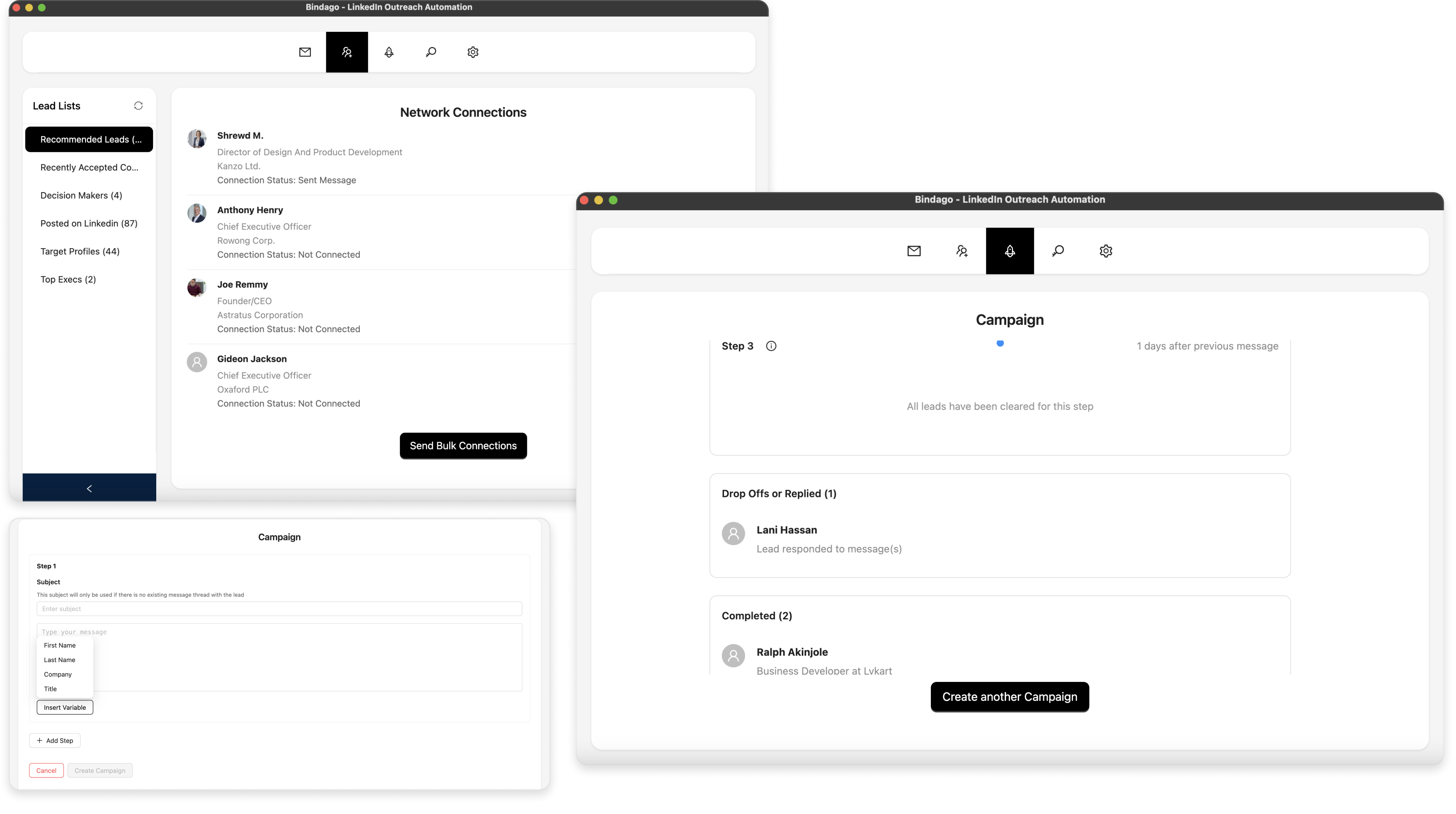
Bindago is a desktop application designed to help sales teams and agencies execute their LinkedIn playbook at scale. Unlike cloud-based tools that can pose a security risk, Bindago keeps your and your clients' credentials secure on your local machine.
Here’s how Bindago helps you implement your playbook:
- Centralized Management: With Bindago's Scale plan, a sales manager can manage unlimited LinkedIn accounts from a single dashboard. This allows you to set up, run, and monitor campaigns for your entire team, ensuring everyone is following the playbook.
- Automate Your Plays: You can build your standardized outreach cadences directly into Bindago's Campaigns feature. Create multi-step campaigns that automatically warm-up prospects, send personalized connection requests, and execute your value-driven follow-up sequences.
- Ensure Brand Consistency: By using Bindago's message templates, you can ensure that every message sent by your team is on-brand, professional, and effective.
Using a tool like Bindago allows your team to focus on what they do best: having strategic conversations with the warm, qualified leads your system generates.
Pillar 6: Define and Measure Key Performance Indicators (KPIs)
To know if your playbook is working, you must measure it. Your playbook should define the key metrics your team will track.
- Leading Indicators (Activity Metrics):
- Connection Requests Sent
- Connection Acceptance Rate (Goal: 30%+)
- Messages Sent
- Response Rate (Goal: 20-40%)
- Lagging Indicators (Outcome Metrics):
- Meetings Booked (The most important KPI)
- Opportunities Created in CRM
- Pipeline Generated
- Deals Closed from Social Selling
Review these metrics as a team every week to identify what's working, share best practices, and refine your playbook.
Conclusion
A social selling playbook transforms your team's LinkedIn efforts from a chaotic free-for-all into a disciplined, predictable engine for revenue. It aligns your team around a common strategy, ensures a consistent brand message, and provides a scalable system for growth.
The framework is simple:
- Standardize your brand.
- Define your target.
- Create your engagement and content plan.
- Codify your outreach sequences.
- Systematize your execution with the right tools.
- Measure your results.
Build this playbook, and you won't just be "using LinkedIn"—you'll be mastering it.
Ready to build a high-performing sales team on LinkedIn? Download Bindago today and explore how it can help you scale your playbook securely and efficiently.