How to Tell Your Story on LinkedIn Without Oversharing
LinkedIn has transformed from a simple online resume into a dynamic platform for personal branding. In this crowded digital space, the professionals who stand out are the ones who do more than just list their accomplishments—they tell a compelling story. Storytelling is the most powerful tool we have for building trust, creating genuine connections, and attracting opportunities.
But there's a fine line between authentic storytelling and uncomfortable oversharing. How do you share your journey in a way that builds your brand without revealing too much or appearing unprofessional? This guide will provide a clear framework for telling your story on LinkedIn effectively, helping you connect with your audience and grow your influence.
1. Define Your Professional Narrative
First, understand that your "story" on LinkedIn is not your entire life story. It's your professional narrative. It’s the "why" behind your career, the challenges you've overcome, and the expertise you've gained along the way.
Before you write a single post, ask yourself:
- What is the core message I want to convey? (e.g., "I am passionate about helping startups scale," or "I believe data can transform marketing.")
- Who is my audience? (e.g., Potential clients, recruiters, industry peers.)
- What problem do I solve for them? Your story should be framed around how your journey enables you to solve that problem.
Your narrative is the thread that connects your experiences. It gives context to your skills and makes you more than just a job title.
2. Weave Your Story into Your Profile
Your profile is the home base for your story. It’s where prospects and recruiters go to figure out who you are.
Your Headline is the Book Title
Your headline should be a concise summary of your professional narrative. Go beyond your job title.
- Instead of: "Account Executive at Acme Corp"
- Try: "Helping B2B Tech Companies Shorten Their Sales Cycle | Sales Strategy & Process Improvement"
Your "About" Section is the First Chapter
This is where you can truly tell your story. Don't just list your skills; frame them in a narrative. A great structure is:
- The Hook: Start with a question or statement that speaks directly to your audience's pain point.
- The Origin: Briefly explain what led you to this work. What problem did you see that you wanted to solve?
- The Solution: Describe your philosophy or approach to solving that problem.
- The Proof: Mention a key achievement or a piece of feedback that validates your expertise.
- The Call-to-Action: Invite people to connect or start a conversation.
3. Tell Your Story Through Your Content
Your posts and articles are where your story unfolds over time. Instead of just sharing industry news, share your experiences.
- Share Lessons, Not Just Accomplishments: When you get a promotion, don't just announce it. Write a post about the most valuable lesson you learned in your previous role that prepared you for this new one. This provides value to your audience while still sharing your success.
- Use the STAR Method (Situation, Task, Action, Result): Frame your experiences as mini-stories. This is perfect for sharing case studies or lessons from a past project.
- Situation: "We had a client with a 5% lead conversion rate."
- Task: "My goal was to double it in one quarter."
- Action: "I implemented a new lead nurturing sequence..."
- Result: "...and we increased the conversion rate to 12%."
- Be Professionally Vulnerable: Sharing a story about a mistake you made or a challenge you overcame makes you more relatable and human. The key is to always end with the lesson you learned.
4. The Rules of the Road: How to Avoid Oversharing
Authenticity is crucial, but professionalism is paramount. Here’s what to avoid.
- The TMI (Too Much Information) Test: Is this detail relevant to my professional brand or helpful to my audience? Avoid overly personal details about your health, relationships, or family drama.
- Don't Be Negative: Never complain about a past employer, client, or colleague. It makes you look unprofessional and untrustworthy.
- Avoid Highly Divisive Topics: Unless your brand is explicitly built around politics or religion, it's best to steer clear of these topics on a professional network.
- No Vaguebooking: Avoid cryptic posts about personal struggles without any context or resolution. If you share a challenge, make sure there's a valuable lesson for your audience.
The golden rule: Share your scars, not your open wounds. Talk about challenges you have overcome, not ones you are currently overwhelmed by.
5. Use Storytelling to Connect and Build Your Network
Your story isn't just for your profile and posts; it's a powerful tool for outreach.
-
In Connection Requests: A mini-story provides context and makes your request stand out.
"Hi {{firstName}}, I saw your post on the challenges of scaling a remote team. It reminded me of a similar situation I faced a few years ago. Would love to connect and share what I learned."
-
In Follow-Up Messages: After connecting, you can nurture the relationship by sharing a relevant case study or story.
"Thanks for connecting! As promised, here’s a brief story about how we helped a company in your industry overcome [Problem]. Hope you find it insightful."
Scaling Your Story-Driven Outreach
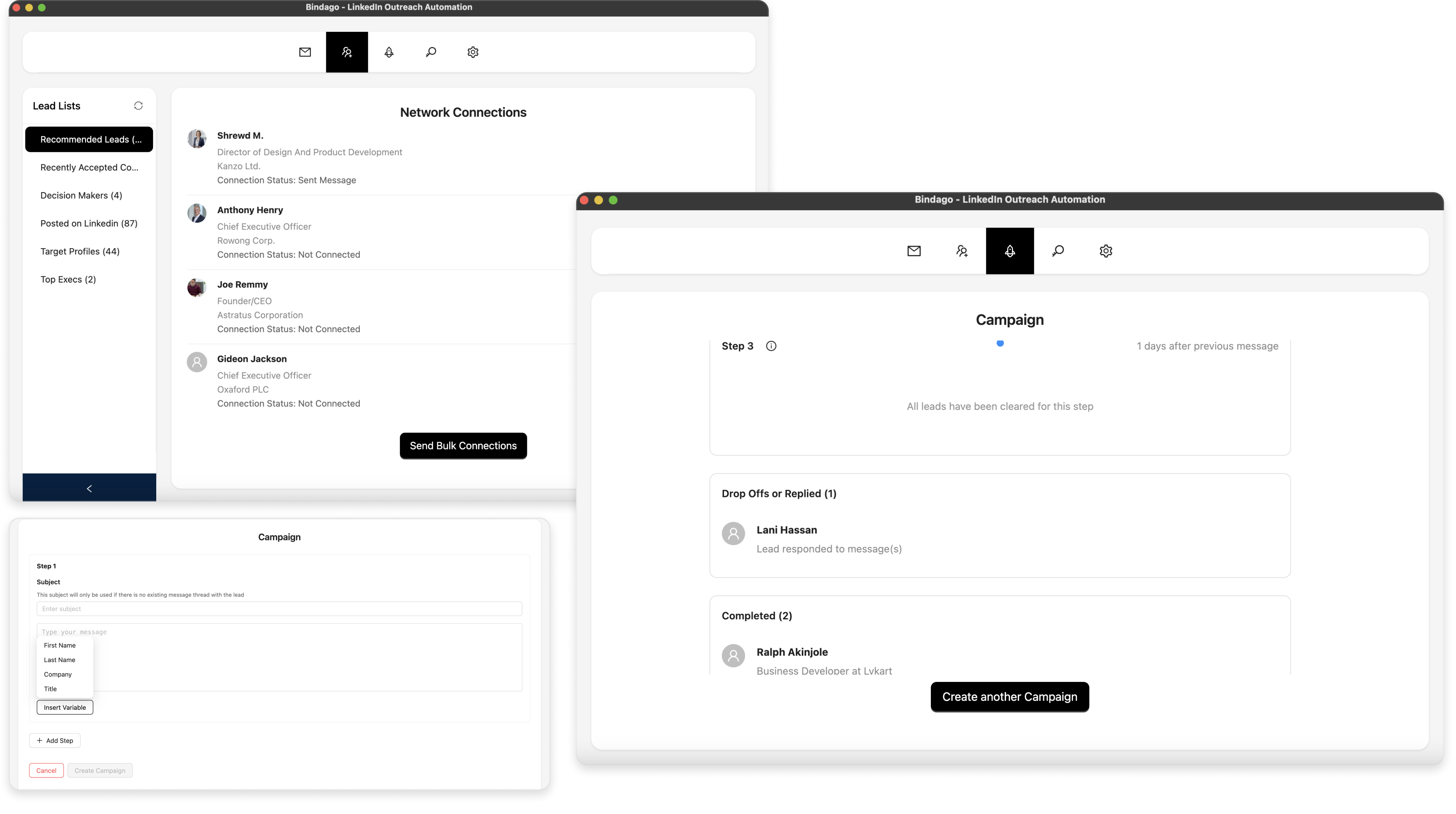
Manually sharing your story with hundreds of prospects is not scalable. This is where you can systematize your approach. A tool like Bindago allows you to build multi-step outreach campaigns where you can weave your narrative into your messaging.
With Bindago, you can create a sequence of personalized messages that tell your story over time. For example, your first message could be a connection request with a brief personal context, and a follow-up message a few days later could share a more detailed case study. This allows you to scale your personal narrative, building trust with hundreds of prospects on autopilot. And because Bindago is a desktop application, your data and your stories remain secure on your machine, never stored on a third-party cloud server.
Conclusion
Telling your story on LinkedIn is about finding the perfect balance between authenticity and professionalism. It’s not about baring your soul, but about strategically sharing the experiences and lessons that have shaped your professional journey.
By defining your narrative, optimizing your profile, creating value-driven content, and using storytelling in your outreach, you can build a powerful personal brand that attracts opportunities and builds lasting trust.
Ready to start telling your story and building a powerful network? Download Bindago today and start your 10-day free trial.